



Do you remember the last time you were lost?
I mean really, really lost. Middle of nowhere. Not another person in sight and no clue which direction was which.
I’m guessing it’s been a while.
Thanks to technology and GPS, we’re always just one app click away from understanding exactly where we stand on this planet.
You want to get un-lost? Just type in your destination and follow the blue line.
What makes a navigation system useful?
It’s not just the amount of map data.
What gets you from Point A to Point B is a system that understands how roads connect, knows which routes are right for your situation, and can give directions based on trusted, current information.
More data doesn’t guarantee better directions. It might just give you more ways to be wrong.
Do you really care that the system read every road atlas ever published? Knowing the side streets of Shanghai doesn’t help if you took a wrong turn outside Albuquerque.
You need the right navigation for you… right now.
The same requirements hold true for AI and service knowledge.
Shift your service AI from book smart to street smart
Just because you’ve connected AI to thousands of manuals, service cases, work instructions, and technician interactions doesn’t make it an instant problem-solving superstar.
Answer quality is directly connected to the quality of the knowledge it’s based on.
Highways are full of drivers who trust their navigation system to get them where they want to go. They trust it not to send them off an unfinished bridge or the wrong way down a one-way street.
That trust is rewarded because a modern navigation system doesn’t just dole out directions based on a 100-year-old atlas. It’s always learning from the real world.
What does this have to do with field service?
Service organizations that keep their AI on a narrow diet of manuals, chats and PDFs are navigating with outdated maps. They’re sending service teams down dead-ends and back alleys.
If you want AI to move from giving related answers to right answers, you need to improve your service knowledge by adjusting these six things: structure, context, validation, permissions, traceability, and freshness.
1. Structure: Help AI distinguish related from right
A navigation system needs to distinguish a highway from a local road, understand where one street ends and another begins, and connect a route to a particular location.
Without structure, the entire system struggles.
Service knowledge has a similar problem.
What if two machines display the same error code but require different actions based on model, software version, or operating environment? Someone familiar with the equipment, might see those distinctions as obvious.
But AI needs things spelled out. And this becomes more important as the amount of information grows.
You don’t make AI smarter by simply adding more documents. That just gives the system more potentially relevant information to choose from.
Structure builds boundaries that help AI tell the difference between similar pieces of knowledge. Structure helps AI determine which applies to the moment.
Your goal isn’t to help AI answer, “What information do we have about this problem?”
You want it to tell you, “What information applies to this specific problem, on this specific asset, under these specific conditions?”
Structure is the difference between a related answer and the right answer.

2. Context: Help AI understand when the answer applies
Knowing that a road exists doesn’t help a navigation system decide whether you should take it.
Calculating the best route depends on where you are, where you’re going, current conditions, and sometimes even what you’re driving.
Service knowledge is equally conditional.
A troubleshooting step may be right for one product but unsafe for another. Repair processes can vary by region. A technique used by a senior technician may require additional training before it’s appropriate for a new hire.
This is context: the information surrounding a piece of knowledge that explains when and why it applies.
Providing context is vital when that knowledge is collected from real service interactions. An experienced FSE rarely makes a decision based on a single fact. They observe, ask questions, eliminate possibilities, draw on previous experience, and then decide what to do.
When you capture the process that led to the resolution, you want AI to understand why it worked and under what circumstances someone should use it again.
Structure helps AI find the right road.
Context helps it understand whether that road makes sense for a particular journey.

3. Validation: Make sure the source can be trusted
You need to trust your navigation system.
Imagine if any driver could add a new road to the map. Some contributions might be helpful. Others might be incomplete, misunderstood, or flat-out wrong.
AI creates a similar challenge for service organizations because it lowers the effort required to create knowledge.
AI can turn service interactions into troubleshooting guides, summarize resolutions, or identify a useful procedure. But the ability to create knowledge quickly doesn’t make it definitive.
Your team needs to understand what was captured, what AI produced, what an expert reviewed, and what the organization has approved.
AI-generated knowledge should not become accepted guidance automatically. You need humans in the loop.
Validation turns captured knowledge into trusted knowledge.

4. Permissions: Make sure the right person gets the right directions
Navigation systems shouldn’t assume all roads are open to everyone.
Some are private. Others restrict commercial vehicles. Some require authorization. Just because a road exists doesn’t mean you’re allowed to take it.
The same principle applies to service knowledge.
An internal troubleshooting procedure may be appropriate for a certified technician but not for a customer. A partner may be authorized to perform only part of a repair. Certain information may be restricted by geography, certification, or contractual relationship.
That’s why AI not only needs to determine, “Is this the right answer?” but also “Is this an answer this person is allowed to receive?”
Permissions help AI respect those boundaries.

5. Traceability: Show where the directions came from
When a navigation system recommends a route that doesn’t look right, you need to understand why.
The same is true when your service AI recommends a diagnostic step or repair procedure.
Every AI answer should have a path back to the knowledge behind it, whether that’s a technical manual, previous case, or knowledge captured from an expert interaction.
That traceability gives technicians a way to evaluate what they’re being told. There’s a big difference between a recommendation based on a current, approved procedure and one from an old, unverified case.
Traceability also gives the organization a way to investigate problems.
When AI produces a questionable answer, users should be able to ask: Was the source wrong? Was it outdated? Was it validated?
Without attribution, the AI response becomes a black box. With it, organizations can follow the chain from answer to knowledge to source.
Traceability helps people understand what an AI answer is based on and whether they can trust it.

6. Freshness: Keep the guidance connected to reality
Maps don’t stay right forever.
Roads close. New roads open. Construction changes traffic patterns. A route that was once the fastest way across town may no longer be the best way today.
Service knowledge evolves in the same way.
Products are updated. Parts are replaced. Software changes.
A procedure can be completely accurate when it’s created and shift over time.
Unfortunately, AI has the power to make this problem worse. An outdated document buried in a repository might rarely be opened. But once AI has access to it, that same document can continue to influence answers across the organization.
That’s why freshness can’t depend entirely on someone remembering to update an article.
The strongest knowledge systems create a feedback loop between what should happen and what’s actually happening on the frontline.
If technicians keep solving a problem differently from the published procedure, that’s a signal. If a new failure pattern appears, that’s a signal. Those signals alert the organization that some of its knowledge may no longer reflect reality.
Navigation systems are more useful when they recognize the road ahead can change.
Your AI-ready knowledge system should be capable of recognizing when service reality has moved beyond the traditional knowledge base.
Freshness keeps the map connected to the territory.
The knowledge underneath the AI
The lesson from this analogy is simple: good directions require more than access to maps.
A navigation system needs to understand what the information means, when it applies, whether it can be trusted, who can use it, where it came from, and whether it still reflects reality.
AI needs the same foundation.
- Structure helps it distinguish the right knowledge from merely related knowledge.
- Context helps it understand when that knowledge applies.
- Validation establishes whether it can be trusted.
- Permissions determine who can use it.
- Traceability makes it possible to verify and govern.
- Freshness keeps it aligned with what is happening now.
The goal, then, isn’t just to give AI access to more service knowledge. It’s to give AI knowledge it can interpret, apply, trust, govern, and keep connected to your service reality.
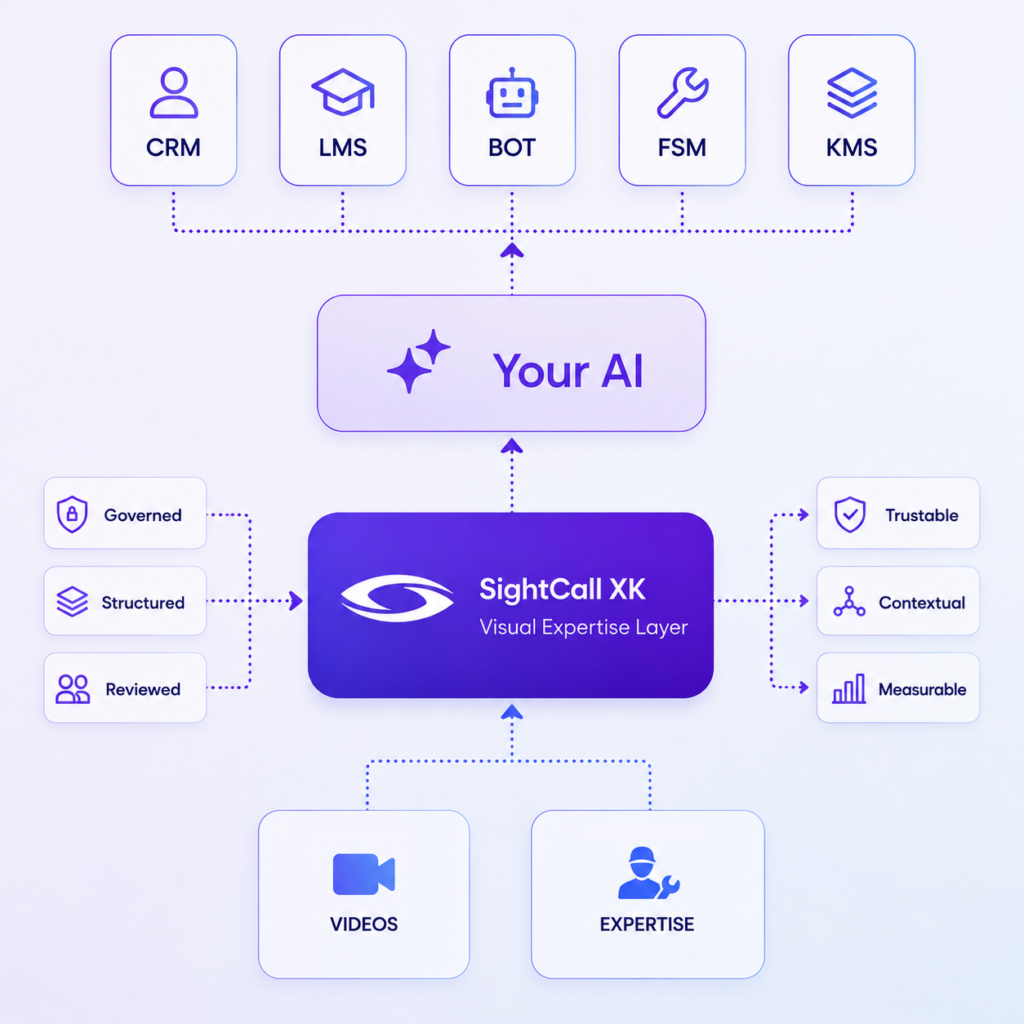
Where Xpert Knowledge™ fits
SightCall Xpert Knowledge™ is designed to help service organizations turn real service work into governed, reusable knowledge.
It captures knowledge from service interactions and uploaded video, then helps teams:
- Structure it into practical guidance
- Review and edit the result
- Approve content before publication
- Organize knowledge around service needs
- Make it searchable and reusable
- Connect it to service workflows
- Prepare trusted knowledge for supported AI experiences
The goal is not to replace existing manuals, knowledge bases, or service systems.
It’s to capture the visual and tacit knowledge those systems often miss—and make that knowledge usable across the organization.