


What service leaders can learn about capturing tribal knowledge, scaling expertise, and building a stronger foundation for AI
Field service has a knowledge problem that’s becoming harder to ignore.
Service Council’s latest Voice of the Field Service Engineer research found that 44% of technicians have been with their current organization for less than five years. And this isn’t simply a story about a younger generation entering the workforce. More than half of those technicians are over 35.
Experienced technicians are retiring. Others are changing employers. And every time they leave, years of hard-earned knowledge about equipment, customers, processes, and the realities of working in the field can leave with them.
At the same time, organizations are investing heavily in AI to make service knowledge easier to access.
There’s just one problem: AI can only work with the knowledge an organization has actually captured.
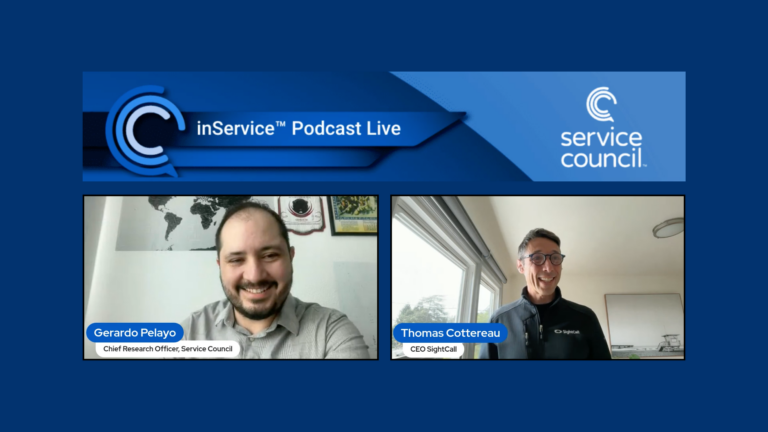
That idea was at the center of a recent inService podcast conversation between Service Council Chief Research Officer, Gerardo Pelayo and SightCall CEO Thomas Cottereau.
The discussion explored how visual AI and video can help service organizations capture the expertise that rarely makes it into manuals or knowledge bases, then turn it into something the broader workforce can use.
Here are five key takeaways from the conversation.
1. When technicians get stuck, they still trust other technicians
For all the investment service organizations have made in knowledge bases, documentation, and digital tools, the most valuable source of help for many technicians remains remarkably familiar: another person.
Service Council research found that 54% of technicians call or text a colleague when they get stuck.
That behavior can easily be interpreted as resistance to new technology. But Thomas offered a different interpretation:
It’s a signal about what technicians actually trust.
I think that’s not resistance to AI. That’s a signal. Expertise is contextual, it’s practical, and it’s also trust-based.
Thomas Cottereau
The colleague on the other end of the phone isn’t just retrieving information. They’ve probably seen similar equipment, made mistakes, encountered unusual conditions, and then figured out what actually works.
That kind of expertise is contextual and practical.
Most traditional knowledge systems only capture the official process. But experienced technicians know what happens when orderly official process meets the messier real world.
That distinction becomes important with AI. Training an AI assistant on manuals and documentation makes existing information easier to retrieve, but it doesn’t give access to everything employees have learned through years of experience.
The biggest opportunity for service organizations is to capture more of that experience in the first place.
2. The best time to capture expertise is while the work is happening
There’s a good reason why tribal knowledge is difficult to document.
Experts often don’t realize how much they know.
Their expertise has accumulated through years of doing the work, watching others, troubleshooting failures, and trying things again and again. Ask an experienced technician to sit down afterward and document everything they know, and much of that context will be lost.
As Thomas put it during the conversation, humans aren’t databases.
Instead of treating knowledge capture as a separate administrative task, what if organizations could save that expertise in the moments when it’s being utilized.
That could happen during:
- A remote support session between a technician and an expert
- A formal equipment training session
- A ride-along or shadowing session during onboarding
This is where video becomes valuable because it captures more than someone’s description of what happened. It captures what they saw and what they did.
The only way to capture this type of knowledge is on the job. It’s when the work happens, using video, audio, text and operational context all together.
TC
Combine that video with audio, text, equipment information, service history, and other operational context? And the organization gets a much richer record of the expertise behind the outcome.
3. AI changes the economics of turning video into knowledge
Organizations could have asked their best technicians to record instructional videos years ago.
But someone had to review the footage, edit it, identify the useful moments, add instructions, organize it, tag it correctly, publish it, and keep it accessible.
Producing polished video tutorials could take weeks and cost tens of thousands of dollars. That might work for a small library of formal training content.
But for capturing thousands of pieces of expertise distributed across an enterprise? It doesn’t make sense.
This is where AI changes everything.
Instead of treating every recording like a video production project, AI transforms raw field expertise into structured, searchable knowledge.
Thomas described how SightCall approaches this by ingesting captured knowledge, mapping it based on information such as equipment, parts, and service type, and automatically creating step-by-step multimedia tutorials from it. Those tutorials can combine text, voice, video snippets, images, and annotations.
We use AI as a tool, not as the knowledge. The knowledge comes from this capture, and then we transform it automatically.
TC
But here’s the big distinction: AI isn’t being asked to invent the expertise. It’s being used to structure expertise that came from humans doing the work.
Human review remains part of the process, particularly when dealing with specialized terminology, acronyms, or company-specific procedures.
That creates a very different model for enterprise AI: capture human expertise first, use AI to make it scalable, then keep humans involved in validating the result.
4. Knowledge becomes much more valuable when it shows up in the workflow
Capturing the knowledge is part of the problem.
The bigger challenge is delivering the right guidance when (and where) someone actually needs it.
Imagine an FSE has a work order tomorrow for a piece of equipment they haven’t serviced before. Instead of waiting until they arrive onsite, what if the relevant expertise found them first?
Thomas shared an example of a customer connecting expert knowledge with its service management system.
When a work order is created for a particular type of equipment and maintenance activity, the system can identify relevant expert knowledge and surface a tutorial directly within the work order.
That moves knowledge from reactive troubleshooting to proactive preparation.
And it points toward a broader opportunity. That same organizational knowledge could support a knowledge management system, LMS, CRM, field service management platform, Copilot, or AI agent.
Rather than creating yet another tool employees have to remember to visit, you make expertise available inside the systems and workflows they already use.
5. Tribal knowledge is becoming a strategic AI asset
Perhaps the biggest takeaway from the conversation is that knowledge capture shouldn’t be treated simply as a documentation project.
The most innovative companies are seeing it as an AI strategy.
Every organization has information available in manuals, service histories, CRM records, and knowledge bases. But the real value lies in another layer of intelligence: the collective experience of the people who have spent years solving its specific problems.
That’s difficult to replicate because it was created through the organization’s own experience.
And when an experienced employee leaves without that expertise being captured, some of that organizational memory can disappear permanently.
Thomas’s recommendation is simple: don’t wait to start capturing it.
“Your operational expertise is one of the few truly defensible assets in the AI era.”
Every expert leaving the company without capturing their knowledge is a permanent operational loss. Companies need to stop treating knowledge as documentation.
TC
The bigger question for service leaders
For years, the knowledge management question has largely been:
How do we help technicians find the information we have?
AI introduces a different question:
How do we capture the expertise we don’t have documented yet?
That may prove to be the more consequential challenge.
Organizations that get the most from AI won’t necessarily be the ones with the most AI tools. They’ll be the ones that can continuously capture what their best people know, turn that experience into trusted organizational knowledge, and deliver it to the next person who needs it.
That turns tribal knowledge from something an organization risks losing into an asset it can continue building.
Watch the full inService Podcast to hear more on video intelligence, knowledge capture, and what it means for the future of field service.