
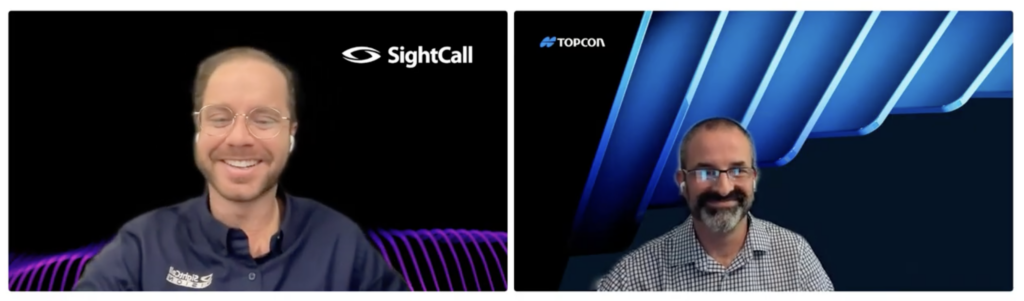
Join David Swift from SightCall and Ben Huber from Topcon Positioning for a practical conversation about how service actually works in the field.
Topcon supports dealers and crews working with highly precise equipment on construction sites, farms, and survey projects, often in remote locations where a single issue can mean hours of travel or multiple return visits.
Ben shares real examples of how problems get solved, from simple setup mistakes that are hard to catch over the phone to costly site visits that could have been avoided with a quick visual check.
They discuss how tools like remote visual support help teams see what’s really happening on-site, fix issues faster, and avoid unnecessary trips.
Webinar Transcript
David Swift: My name is David Swift and I’m the VP of Product Marketing at SightCall. We’re a video intelligence platform and we help service organizations resolve issues in real time with live video, improve efficiency and preserve expertise, as well as accelerate service performance with AI knowledge capture.
And one of our favorite customers is Topcon. And I’d like to introduce Ben Huber. I’ll let you take it away, Ben.
Ben Huber: Thanks for having me. My name is Ben Huber with Topcon. We are a company that makes precise positioning equipment, GPS, lasers, optical equipment.
Precise positioning for the construction, survey and ag industries. If you know precisely where you are, then we can do fun stuff with dozers, motor graders, asphalt, concrete, pavers, sprayers, seeders, planters, all kinds of stuff.
They can take the engineer’s plans or the desired plans and automate the hydraulics or other sensors on the machine to drive cutting edges to exactly what the engineers designed.
David: Thanks for that intro. Something else to point out is that Topcon is also a Five9 customer and SightCall powers the video solution provided by Five9. The combination of video with a multi-channel contact center, has proven to be very valuable to many, many customers.
So, let’s get to the questions. Can you briefly describe your experience in service and support and how your role has evolved over time?
Ben: I’ve been at Topcon for well over 20 years, I believe. I started out on the frontlines doing tech support, training, took a tour through marketing and beta testing and, back into professional services.
More recently, I started to own a lot of the platforms, which is where the Five9 part comes in. I was the one that ran the team implementing Five9, implementing SightCall. Got into the analytics side as well, doing a lot of the metrics beyond just CX metrics, more company-wide business analytics. So operational side, strategic side, a combination of everything.
The Reality of the “Bad News” Business
David: You’re across the business and I think there are not a lot of service professionals who get that type of experience. So, your your input here is extremely valuable. In previous discussions, you’ve said that customer service is often “the business of bad news.”
What does that look like day-to-day for you at Topcon?
Ben: Typically, people aren’t calling their local Topcon person to say, “Hey, I just want to let you know that today everything’s going awesome. Love your product. I gotta get back to work.”
That’s not how it goes.
A phone call or email is typically centered around “My world is falling apart. Something is wrong, and I need you to fix it. Yesterday.”
That’s why I say it’s the business of bad news.
Time is of the essence. Whether it’s a broken product, a new person on a crew that needs some kind of training or support, or it’s been a while since they’ve used something. There’s always some urgency because their day is not going well.
And when that feedback comes in, we’re trying to triage and fix that as quickly as possible, because time is money. Literally.
Because if they’re not able to get their job done, then it’s holding up not just themselves, but maybe additional crews on site. It could be materials that are coming to site. It could be a farmer missing a weather gap where they can plant versus not plant because rain is coming.
There are all kinds of things that could be time sensitive, and we’re trying to get back on track as soon as possible.
Why Video Changes the Support Conversation
David: I think that’s a great perspective. Solving complex problems in service. You know, I imagine that all those calls are very, immediate needs. In terms of delivering service, and we are here talking about video, what do positive moments look like for you? In the context of video support.
Ben: Yeah, so I’ll back up a little and bring in the Amazon concept of reviews, where typically if you’re going to buy a product on Amazon, you’re going to see a lot of five star reviews.
Hey, I just bought this product. I can’t wait to give it to my granddaughter.
Okay, that’s not even a review. That’s possibly a paid review. But then you have ones where something went horribly wrong. Typically, you’re not going to get a whole lot of the twos, threes and fours, unless someone’s really being intentional.
It’s either really good news or really bad news. And obviously we’re trying to aim for the really good news and we’re trying to make that a positive experience because they’re already in a bad situation.
They’re coming to give, in essence, a one-star review on their day. It may not be a one star review on Topcon or the product, but by the time they’re calling us, they are trending towards a one-star review for how their morning is going, how their day is going, and they want to get back to a five because they’ve got to get stuff done. They’ve got to be productive.
If a picture is worth a thousand words, then a video is worth a thousand pictures.
You’re trying to solve these issues quickly, and you want to get to the root cause of what is going on. Sometimes that could be a training issue, and they’re just the wrong person on site. Sometimes it’s not necessarily the hardware or the software that’s the issue.
It is truly the job environment. And there’s so many variables that could be at play that it’s not just as simple as, hey, you rebooted your computer, is it plugged in? That’s not the level of triage that we’re looking at. It is trying to look at a whole host of visible and sometimes invisible scenarios.
Near an airport or a military base, all kinds of radio wave signals could be at play. That could be interfering with Bluetooth and Wi-Fi and impacting things. It could be visible things like a building is too close, or trees, or inside a tunnel, or all kinds of different scenarios that could be involved here.
And you’re trying to assess as quickly as possible what is going on with that customer to know which route you need to go—from a troubleshooting and support standpoint—to get them to a resolution.
The Difference Between Asking and Seeing
David: That’s great insight. I was wondering if you could share a specific example, from your tenure at Topcon, when video support delivered real tangible value?
Ben: I’ll go with two. One where I wish I would have had video, and then we’ll get to one where we did.
So, people might be familiar with things that could share the screen of your computer or maybe even a mobile tablet in the field.
And those are great to troubleshoot support of software issues, where, if I can see your screen, I can walk you through. “No, click there. Oh, I can see that you’ve got this setting wrong up there in the top right-hand corner.”
Again, those eyes-on scenarios. But it’s literally only the screen and it has nothing to do with the environment around them.
Having those was great but wishing that we had more. I had a job where I had to go to an airport. They were doing a paving job on an airport, and the contractor was telling us that our system was wrong. I was like, okay, I kind of doubt it, but it was a high-profile job at an airport. So, I had to drive.
You probably don’t know this, but anytime you’re doing paving on an airport, that means nighttime. Once the airport is no longer taking arrivals and departures, when there are no airplanes landing on the runway, we can work.
We started at like 11:00 at night. We go out there and we start milling the runway, paving the runway, and I’m checking things.
Everything looks great. The guy comes up to me and says, yeah, I just checked it and it’s wrong. I say, what do you mean it’s wrong? I just checked everything. It’s right.
He was checking this $100,000 system with a $50 smart level that he had mistakenly put in degrees of slope, and the plans called for a 2% slope on the runway, and we were hitting 2% exactly. He had it in degrees.
I wasted my entire trip because he’s checking our expensive system with a cheap Home Depot level.
So he wasn’t, I don’t want to say, not smart enough to, but inadvertently put it in degrees versus percent slope. If I could have seen that, it could have saved me the time and money and the lack of sleep from working a night job and saying you’re doing it incorrectly.
With video, I can see exactly what the problem is from thousands of miles away.
And that’s the place where I wish we would have had a solution like, SightCall. Now, jump forward to having SightCall. We had a call come in. Guys were complaining, hey, the system’s not working.
It’s the things you don’t think to question, or the things they don’t think to tell you is the problem.
And suddenly the the support agent is looking at the video and they say, hey, can you zoom in on those cables there? I want to see the part numbers on those cables. So he brings the camera in and starts looking at them. He knew right away, as soon as he got close enough to see the part numbers on the cable, he had put the wrong cable in there.
But he would have sworn up to that point that he had installed everything correctly and the problem was with our system.
We told him to go back and quality control that… because as they were looking at it, it looked to them like he had flip flopped two cables. We told him once we saw that, but if we had just been asking questions, it was going to take multiple visits.
Maybe we’d have to send someone out into the field to confirm. They would have seen those cables reversed. But that was something we were able to catch on video because we happened to see it in the background. He looked at it, and you know—face palm—he knew the problem.
He said, okay, I’m sorry, I’ll fix it. I got it from here. It’s probably not the system at all. He called back later and said, yep, that fixed everything. No problem.
Well, that saved that dealer representative multiple trips to that job site that he wouldn’t be able to bill for because it turned out to be his error. They have to eat that money. So, for us to be able to catch that, it saved him time, made the customer happy, made us happy, wrapped it all up in one quick call because we happen to have SightCall.
The Ripple Effect of Faster Resolution
David: That’s great. And just to expand on that, what makes those moments so valuable to Topcon? Can you talk about saving money and time? What else is in there to unpack for Topcon?
Ben: Sure. It is time and money saved because again, some of these job sites, if you think about Montana or some of those large states out west… a lot of those are remote scenarios where a guy might be covering half the state of Montana, and it’s going to take him hours to get to the job site.
He left his house at 4 in the morning, gets out there 4 or 5 hours later. We give him several things to check. Then he goes home, check some things, goes back out there, multiple trips. That’s time and and money lost. Frustration from the customer experience. Now they’re losing faith in the product, in the solution, in the individual who was driving out.
So we’re saving our brand name for Topcon, for the local dealer, and for that individual. We’re helping protect all that brand and name recognition and reducing frustration across the board. It makes that operator more productive, which makes his boss happier because he’s more profitable and everyone has more faith in the entire system.
The more we can increase that faith, word of mouth spreads. You know, they say that the best marketing is the moms club. If they can talk up your product among their girlfriends, it doesn’t matter how many millions of dollars you spend in marketing, you’re not going to outweigh word of mouth in that group.
The same is true in our industry. It’s not a mom’s club, but it’s still a small enough industry that that word of mouth spreads when they see, a positive outcome from these kind of scenarios.
Beyond the Video Call
David: That’s great. We have a question from Richard and it kind of segues into the question I have about measuring service impact and traditional systems.
Richard asked, “Why, in the example you gave, could that not have been done with a WhatsApp video call? Also, what happens in in low Wi-Fi areas? Or no 5G signals like a basement in areas like that, etc. for Topcon?”
Ben: Part of it is the integration. If you can’t integrate into the rest of my enterprise platforms, you’re nothing more than a parlor trick.
That’s where I would dump WhatsApp. Yes, there are some integrations that WhatsApp can do, but the fact is that we can integrate this straight from Salesforce. Salesforce is our CRM, so the support agent isn’t having a separate phone call through WhatsApp.
They’re able to initiate this, send the text to the customer. The amount of metadata and metrics that are captured in that system are all tied together as opposed to us solving this through a WhatsApp call that I have no metrics on. I have no way to justify the expense of any of this to the powers upstream from me.
I need to have those metrics around why CSAT scores are going up or NPS is going up, or call is volume going down, whatever the metric is you’re trying to prove. If I have all these fractured systems that aren’t tied together, that’s a loss on my part. As the architect of a lot of these platforms, I refuse to allow that because I won’t have the ability to show the interaction.
And then I’ve got to monitor one more platform. I got these metrics over here, and these metrics over here, and I can’t prove that any of them correlate to anything.
And sure, I can tell a story that one causes the other, but when all those platforms are tied together, it’s easier from an agent experience, from a manager’s experience, and from an executive experience to understand how those work together.
And capture all the data. At the end of the day, data is king, and the more I can map about my customers, my products, my processes, the better it is for me to be able to to prove value.
Capturing Knowledge in the Moment
David: If I may add to that portion on connectivity, SightCall recently released a new, feature within our product, which is a pre-call visual data collection.
We call it SightCall Snap, and you can take photos and videos that can be linked into that session. You could send a link to that technician on site so they can collect visual information offline and it uploads automatically when they return to an area that has connectivity.
And then you start the call and have the visual context available. So it’s a more asynchronous collection of that visual context.
And Richard just said that “the video data can be saved for future training material if using an integrated system.” You’re absolutely correct, Richard.
Ben, are you recording any of these video interactions?
Ben: It depends. I have some because they’re great for internal meetings or even with dealers. I used one, last call at one of our dealer meetings from the main stage. I turned off the audio so that no one could detect who the voice was. I didn’t wanna embarrass the guy.
I used video from the cable call that I told you about. I put it up on screen to show people that the call was there, that the agent detected, that had the operator look at it, identify the problem, and move on.
But I didn’t want to embarrass anybody in the room by actually calling out the dealership or the individual.
From Knowledge Bottlenecks to Knowledge Scale
David: Richard, you’re asking some great questions and as a leader of product marketing, I can’t help but put in a plug for another product we have called Xpert Knowledge™, which takes all of those video recordings and turns them into structured tutorials for training materials, for future onboarding, and even for reporting purposes.
Essentially, we’ll take that video recorded through SightCall, and use AI to parse through all the footage, transcripts and any images and turn it into a multimedia, knowledge object that’s scaled across the service ecosystem.
But let’s get back to Topcon. I’m curious, how do you see support evolving over the next few years for Topcon?
Ben: That’s a great question. Obviously, there are labor issues everywhere. We have a very technical, complex product portfolio that we’re trying to leverage in these scenarios. You can’t just take someone who used to stock shelves at the grocery store or sell stereos at Best Buy, they’re not going to step into this role and be an expert on day one.
It takes a long time to ramp them up with that product expertise. So, the more that we can provide virtual agents to handle the stupid questions and only escalate the more difficult ones to the product experts, the better.
Then the new people can shadow product experts to gain that knowledge, or to read through the training material and get them up to speed faster because they’re not wasting their time as much on those simple questions.
Virtual agents can assist the human agent to answer them, so they look smarter on day one and they can still escalate the more difficult ones to the second, third, fourth level of defense.
I think that that’s a huge piece, being able to deflect, either automatically without a human or taking an untrained human and allowing them to have the knowledge to answer those questions at the easy level.
Freeing Experts to Focus on What Matters Most
David: It sounds like, from your perspective, it’s not replacing humans. It’s really about deploying them where they matter because the issues are complex. There are difficulties, with hiring and training and onboarding, and these experts need to support the most complex problems, which are often the most valuable interactions that Topcon might have.
Ben: There’s no replacement for going in the field and seeing a product in action and picking up those things that, yes, maybe we can catch on SightCall, maybe we can’t.
Maybe there’s still training or the actual installation you must do. To get that information takes time. I got to hop on a plane, I got to go somewhere, and I have to go on site, as opposed to a phone call that is going to be less than 20 minutes.
The number of phone calls you’re going to miss by going out in the field… I’ve got to do something to still help them. People can’t just go out in the field and leave the phone’s ringing off the hook. So you have to be able to have that time.
In an ideal world, we’re using the virtual agents to handle the simple questions, so it frees the time of whatever level of agent to create more content based on their expertise. Content that can feed into the virtual agents, to free up more time for those agents to create more content.
It’s this perfect snowball of heading towards perfection… the more that we can harvest out of people’s minds, not so we can get rid of them, but so they can be utilized elsewhere. Either in product development or support, but handling higher level issues, helping sales teams. There are a bunch of ways to take the wealth of knowledge in their heads and leverage it elsewhere in a way that AI is not going to be able to do.
It’s that problem solving piece of discerning where and when to apply knowledge that AI isn’t going to be able to replace. If you can free them from menial tasks, that’s where the virtual agents are helping us to then be able to reapply the expertise of these subject matter experts in ways that bring value to the company.
They’re not wasting their time on, “Is it plugged in?” or “Did you reboot the computer?” Those kinds of simple questions that should be self-help from a virtual agent. We freed them up to handle the more complex issues or create documentation to help with those more complex issues or help create a better product.
Creating Space for More Rewarding Work
David: That’s a fantastic perspective. And I imagine that a lot of these folks who are not being forced to solve the menial tasks are happier in their job, right?
There’s a lot of value by people talk about shifting left and it’s like, oh, we’re just gonna replace everyone with, with AI. But I mean, I call we’re all about augmentation, right? We’re all about improving the experience of team members. And with video, that’s a way to help in that process for sure.
Ben: For sure. They’re already in the business of bad news and dealing with frustrated people all day. To deal with stupid questions on top of frustrated people just makes that agent’s life less enjoyable. To be able to deflect and give them the chance to have the excitement and joy you get when you solve a significant pain point as a support agent.
That energizes you to go back and do it again tomorrow.
If you’re spending the majority of your day answering stupid questions, you become a piece of the matrix. You’re not finding enjoyment, you’re just part of the machine, and it’s harder to get motivated in the morning to start picking up that phone call from a disgruntled end user or dealer.
When Traditional Service Metrics Miss the Point
David: Yeah, absolutely. Final questions for you. What have you learned in support that really works and what really doesn’t work?
Ben: Some of this is unique to us. I’m not trying to say this works for everybody.
We found that, new people come in and you end up with a new boss who’s all about average handle time or how many cases you can close. We talked to some of our dealers and what we found is, “I don’t care about average handle time. I just want the actual resolution.”
“Don’t close a case with a resolution that says, ‘go try this’ and then hope I don’t call back. I don’t care if the case stays open a long time.”
I’ll go back to the Montana scenario. We might give them something to go check, and it takes them 4 or 5 hours to drive there.
They might not have time in their schedule this week, depending on the urgency of the customer and everything else. So it might turn into multiple days before they get a chance to go out there to try a potential scenario or get feedback on… What size was the machine? What version of the software is running?
Who knows, there could be a fair amount of information they have to collect for us, but it could take days to get there. They don’t care that the case stayed open. They just want to know that we’re still on it. They get us the answer to those questions. We iterate and work towards a resolution.
Once we found that out from them and realized it’s not a matter of a typical call center—average handle time and number of calls you’re taking per day—that didn’t matter to our dealers.
They just wanted the right answer.
Well, that freed the agents up. If it’s truly a support scenario, take the time to solve it and get it done and get it done correctly as close to the first time as possible, but not first-call solution. We don’t care about that either. It’s great if it’s a first-call solution but knowing that it could take six calls is also okay.
Because now that we’ve talked to the dealers, we’re all on the same page about what success looks like. And that was an eye opener for us. Don’t just go to the internet and search “what success metrics are for a call center” and apply that to your company.
That could be true. It could not be true. But ask “would this look like success if we did this?” And turns out the answer on a lot of those was “no.” Solving problems in one visit wasn’t necessarily a possibility. It was great when it happened, but realistically, it wasn’t what was happening in most of our scenarios.
And don’t then rely on these overly rigid metrics. There’s nuance to a lot of these that don’t easily show up in a dashboard. And so for us, it turned into, no news is good news because back to the Amazon, one star and five star reviews. The five stars are very rare.
We would get the phone call or email that said, “I just want to let you know. Awesome experience with support there. It fixed the problem. The customer was happy I was able to do an additional sale there.”
Those get sent up the food chain all the time because they happen so rarely. But when they do, it’s a broad distribution. We always hear the bad news.
When we hear silence, that’s actually a good sign.
I can look at a specific rep or dealership or territory and if calls are going down… that’s actually good news for us. We have done a good job supporting them, of giving them self-help information.
So it’s a completely different metric for us. What we’ve learned over time is not to be rigid on what is typical but make sure that how your company does business is being measured correctly with your target customer.
Measuring Success Through Customer Impact
David: It does. It sounds like anecdotes are super powerful. I’m wondering if you can expand on why that is and what moves the needle for Topcon.
Ben: Again, back to our complex product portfolio. We have some products that are very simple, very straightforward. And you can probably take, 20 calls on that in a day without any issue. Other products, it could literally be days that you’re in there.
So being able to measure that internally and get that feedback of, hey, it was labor intensive, but we understand that, the customer understood that, the pricing of the product and the solution is kind of baked in.
We realized this is not as simple as just flicking a switch. There are levels of training that I need to have from an operator, from a salesperson, from whatever. We can’t just throw a new hire on this system and expect success.
But when you hear those anecdotes that you’re talking about… “I was able to take a junior dozer operator and turn him into performing like a 20-year veteran in a very short turnaround because of your product, because of the support that came from the dealer, because the training material that you guys had.”
Those are the kind of anecdotes that drive the idea that have the right products. We are selling in the right way. We are supporting in the right way, with the right distribution network.
All the different pieces show that the overall solution is working correctly in how we’re providing information.
Let Your Customers Define Success
David: That’s great. And maybe a closing question. If you had one piece of advice, to give service leaders, what would it be?
Ben: Talk to your customers. Now, it’s not always easy depending on whether you’re B2B or B2C.
Understand from their side what it’s like to do business with you. That’s really the root of what I was getting at before, with that average handle time.
What is it like to do business with Topcon? It turns out how we were trying to do business with them is not what they wanted. So, the better you can do at finding out what success and failure looks like for them doing their job, for them having a relationship with you…
You want to put yourself in their shoes—literally— as much as possible. That should drive what your metrics are, what your SLAs are, and what your plan is for doing your job well.
As opposed to asking an MBA or, you know, other experts in the field. If they’re not in your field, then they don’t really know. They can give some general best practices and maybe some things to look for, but only your company is going to know who your customers are.
And you might have competitors, but even their customers might not be 100% overlap with your customer base. Your competitors don’t have a 100% Venn diagram overlap of customer pain points and personas. You need to find out what your people need and reflect that in your service offerings.
And it’s going to be different for everyone. There is no one size fits all, but the better you can do with understanding that relationship, and meeting that need, the better you’re going to be at making five-star customers who are really pleased with your product. And you’ll keep them from having one star days.
David: I think that’s fantastic advice.
I think we touched on a lot. And again, this, this fireside chat will be shared out to all, the registrants and attendees.
And I would just like to extend a, a thank you to you, Ben, for coming on for this fireside. And, thank you to top con as well. This was really informative.
*Portions of this transcript have been edited for clarity.