

David Swift:
Hello, and welcome to the first webinar in our Video Intelligence Conference series, hosted by SightCall. We’re excited to share some important updates about our products and discuss the trends we’re seeing across the service industry.
Today’s session is titled “How to Capture and Scale Service Expertise Without Adding Overhead.” This is a major challenge facing field service organizations today, and we’re looking forward to sharing insights and practical solutions.
Before we begin, I’d like to introduce our speakers.
First, we have Thomas Cottereau, CEO and Founder of SightCall. My name is David Swift, and I lead Product Marketing at SightCall. We’re also joined by Bogdan Cirlugea, our Head of Product and the driving force behind many of the exciting innovations you’ll see demonstrated today.
We’re especially excited to show you a live product demonstration later in the session.
With that, I’ll hand things over to Thomas.
Thomas Cottereau:
Thank you, David.
I’d like to start by discussing what we call the Field Service Knowledge Crisis.
Based on extensive industry data, I believe that field service organizations today don’t have an AI problem. They have a knowledge problem.
Organizations are losing expertise faster than they can capture and document it, while service complexity continues to grow. Several forces are driving this challenge simultaneously.
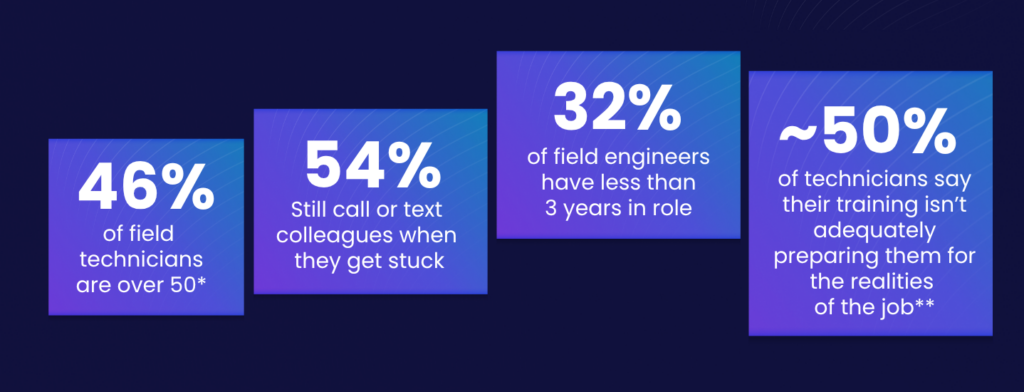
First, there’s workforce disruption. As shown in these statistics, 46% of field technicians are over the age of 50, meaning a significant portion of the workforce is approaching retirement.
Second, when technicians encounter problems in the field, 54% still rely on calling or texting a colleague for help. That tells us critical knowledge remains trapped in people’s heads rather than being accessible across the organization.
Third, 32% of field engineers have fewer than three years of experience in their current role, highlighting the ongoing challenge of onboarding and knowledge transfer.
Finally, nearly 50% of technicians report that their training does not adequately prepare them for real-world service situations.
Taken together, these statistics reinforce a simple conclusion: field service doesn’t have an AI problem. It has a knowledge problem.
Let’s take a closer look at what we call the perfect storm facing service organizations today.
First, there’s the workforce challenge. Experienced technicians are retiring, while new employees are entering the workforce with less hands-on experience. As a result, the skills gap continues to widen.
At the same time, valuable tribal knowledge is at risk. As senior technicians leave, they often take decades of expertise with them. That knowledge is difficult to capture, difficult to scale, and often difficult to trust once it’s documented.
Finally, customer expectations and service complexity continue to increase. Products are becoming more sophisticated, technologies are more interconnected, and customers expect faster resolutions than ever before.
The impact is significant. Customer satisfaction declines, repeat service visits increase, and operating costs continue to rise.
So how do we close this gap?
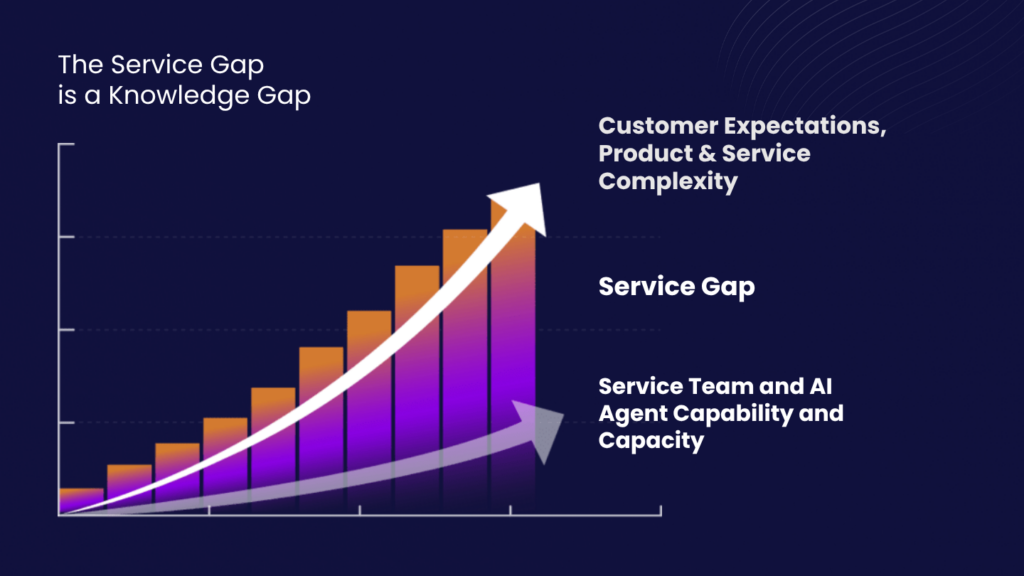
At SightCall, we’ve traditionally focused on what we call the service gap. The gap between an organization’s service capacity and capabilities and the expectations of its customers.
Today, however, that service gap is increasingly becoming a knowledge gap.
Even as organizations expand service teams and introduce AI capabilities, product complexity and the pace of technological change continue to accelerate. The challenge is no longer simply having enough people. It’s ensuring those people, and increasingly AI systems, have access to the right knowledge at the right time.
Let’s consider one simple reality: when experts leave an organization, their knowledge often leaves with them.
Think about the last time one of your most experienced technicians retired. What happened to their expertise? In many organizations, much of it simply disappeared.
This isn’t just a knowledge management issue. It has direct financial consequences.
When expertise is lost, onboarding new technicians becomes more difficult. Time-to-proficiency increases, and organizations struggle to get new employees productive quickly.
This challenge is especially significant when you consider that many newer technicians no longer stay with a single company for decades. While previous generations often spent 20 or 30 years with one employer, today’s average technician tenure is closer to three years.
If it takes two years to fully train a technician, the economics become difficult to justify.
The result is longer onboarding periods, lower first-time fix rates, more escalations, additional dispatches, and ultimately higher service costs. Ironically, these outcomes are the exact opposite of what many organizations hope AI will deliver.
Industry data supports this reality.
According to Aquant’s 2026 research, approximately 20% of service costs are linked to failed service visits. Among lower-performing organizations, that figure can climb as high as 44%. Aquant also estimates that organizations can achieve up to 26% cost reduction through better service intelligence.
TSIA’s 2026 research identified the talent shortage as the number one challenge facing service organizations today.
Similarly, Service Council research found that 83% of technicians believe the knowledge required to service products is changing rapidly, and that today’s service roles require significantly more technical expertise than in the past.
All of these signals point to the same conclusion.
Yet there’s one surprising blind spot.
As highlighted in the white paper we released last year, virtually every company is investing in AI. However, very few are investing in the knowledge foundation that AI actually requires.
And that’s important to remember.
AI is only as effective as the knowledge and data that power it.
With that context in mind, let’s take a look at what service leaders are telling us.
David:
Thank you, Thomas. Those insights really resonate with what we’re hearing from our customers.
Across the surveys we’ve conducted, one theme consistently stands out. The biggest challenges facing service organizations, both externally and internally, revolve around the workforce. Whether it’s the ongoing talent shortage or the need to better train, engage, and retain existing employees, workforce-related issues are driving many of today’s service challenges.
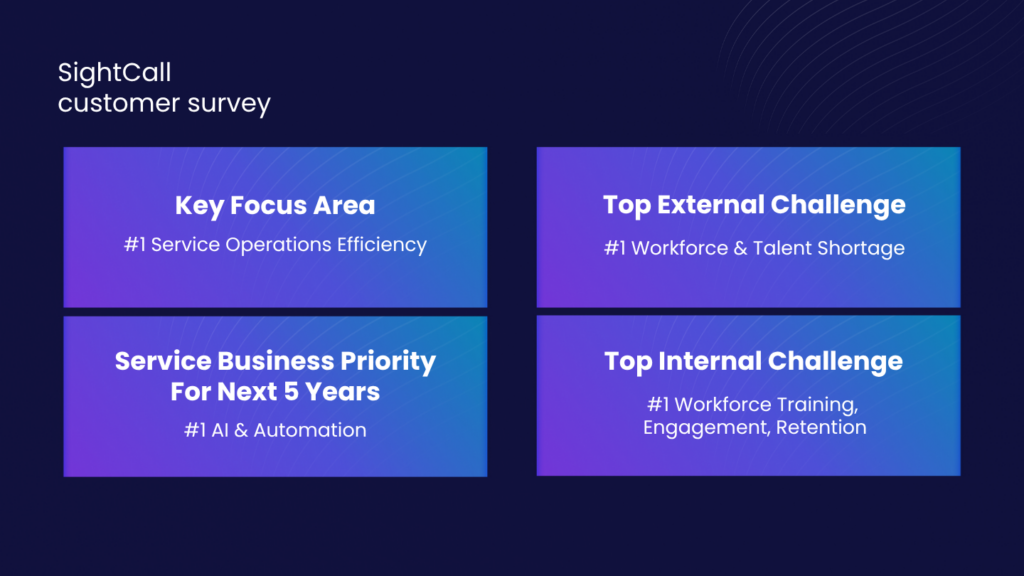
Not surprisingly, these challenges directly impact what our customers identify as their top priority: operational efficiency.
Service leaders understand that without an efficient, capable workforce, it’s nearly impossible to achieve the KPIs that drive service performance and customer satisfaction.
And as Thomas mentioned, our survey results closely align with broader industry research. Across our customer base, the number one strategic priority over the next five years is clear: AI and automation.
That led us to ask a simple question:
What if you could scale the way your experts and trainers solve complex issues, elevate average performers into top performers, and do it faster than ever before?
We explored that question with several customers.
At Peak Scientific, they shared that their top five failure causes account for nearly half of all service calls. Capturing the expertise and troubleshooting approaches used to resolve those issues would create tremendous value for onboarding new technicians.
They also highlighted another challenge: onboarding technical support specialists. These individuals often provide remote assistance to technicians in the field, making their expertise critical to service success. Faster onboarding and accelerated proficiency would deliver meaningful business value.
We asked Canon a different question:
What if you could reduce the time and cost of technical content creation by 80 percent?
Their response was immediate. Creating technical content is both expensive and time-intensive. Distributing that content across the organization adds another layer of complexity. Canon emphasized that producing and maintaining meaningful knowledge assets remains a significant operational burden.
We also spoke with several global home device manufacturers and asked:
What if recorded service interactions could automatically become scalable organizational know-how?
Their feedback was consistent. They want to scale expertise faster without pulling experienced employees away from their day-to-day responsibilities. Creating multimedia instructions and training content consumes significant time and resources, especially across large product portfolios. They want to automate the process, but many haven’t found a practical way to do so.
Even in the healthcare technology sector, we heard similar concerns.
When we asked one of the world’s leading healthcare device manufacturers:
What if tribal knowledge could be easily documented and instantly retrieved?
Their response echoed what we’ve heard throughout the industry. Creating knowledge assets is difficult and time-consuming. As a result, many known solutions never get documented at all. Valuable expertise remains trapped within individuals instead of becoming an organizational asset.
That brings us to the central challenge:
How do you capture expertise without asking technicians to become documentation writers?
Technicians are often among the most knowledgeable people in an organization. The same is true for the support engineers who assist them. Yet neither group wants to spend their day creating manuals or writing documentation.
At the same time, documenting complex procedures requires significant effort, creating a bottleneck that limits how quickly knowledge can be shared and scaled.
At SightCall, we believe the answer is Video Intelligence.
Video Intelligence enables organizations to capture service expertise and transform tribal knowledge into trusted, reusable assets that can scale across the entire enterprise.
At its core, Video Intelligence combines three key capabilities.
The first is Remote Visual Support.
This allows experts, technicians, and customers to connect through live video interactions. Using tools such as augmented reality annotations, screen sharing, and mobile collaboration, organizations can resolve issues faster while reducing unnecessary site visits.
The second capability is AI-Powered Insights.
Our customers told us that resolving issues remotely wasn’t enough. They wanted to understand what was happening across those interactions.
By analyzing service conversations and interactions, organizations can uncover operational trends, identify recurring issues, detect knowledge gaps, and better understand root causes. Service leaders can ask SightCall’s AI detailed questions about service performance, parts issues, troubleshooting trends, and more, enabling more informed decision-making.
The third capability, and perhaps the most transformative, is Xpert Knowledge™.
Every service interaction contains valuable expertise. Instead of allowing that expertise to disappear once an issue is resolved, organizations can capture it, structure it, and scale it instantly.
A remote support session can automatically become a step-by-step guide. A technician’s recorded repair procedure can become a reusable knowledge asset. Even videos recorded independently in the field can be transformed into structured expertise that benefits the entire organization.
The result is a living knowledge library built from real-world service experiences.
For new hires, this means immediate access to proven troubleshooting methods and expert workflows. Instead of relying solely on classroom training or static documentation, they can learn from the actual experiences of top-performing technicians and engineers.
That accelerates onboarding, shortens time-to-proficiency, and helps organizations achieve the service efficiency metrics that matter most.
With that, I’ll hand things over to Bogdan so you can see exactly how all of this works in practice.
Thomas:
Thank you, David and Bogdan, for that excellent presentation.
I’d like to close by talking about the future and the major shifts we believe will shape service organizations over the coming years.
The first trend we’re seeing is a fundamental change in how organizations think about knowledge.
The most innovative service organizations are moving away from what I would call static knowledge.
For decades, we’ve approached knowledge management the same way.
Someone documents a process, publishes it, and moves on. The problem is that knowledge begins aging the moment it’s created. It quickly becomes outdated, it’s often difficult to find, and its quality depends heavily on the individual who originally documented it.
As a result, organizations end up with large knowledge repositories that are expensive to maintain and often underutilized.
This isn’t just our perspective.
In Gartner’s 2025 report, Solution Path for Knowledge Management, they highlighted several findings that align closely with what we’re seeing in the market.
First, Gartner notes that formal documentation and curated knowledge bases remain important, but they represent only a fraction of the know-how that exists within an organization. Most expertise still resides in people’s heads.
Second, employees rarely have the time or responsibility to continuously document and maintain knowledge, leaving knowledge management programs chronically under-resourced.
And perhaps most importantly, Gartner concludes that AI and machine learning do not eliminate the need for strong knowledge management practices. In fact, they make those foundations even more important.
Their recommendation is clear: organizations should move toward capturing knowledge in the moment and enabling continuous improvement through collaboration and feedback.
That’s exactly what we mean when we talk about living knowledge.
Knowledge is no longer something that should be created once and forgotten. It needs to evolve alongside products, processes, and customer expectations.
Instead of relying on a small centralized team to manage knowledge, organizations need a model where expertise is continuously captured across the business, directly from the people doing the work.
That knowledge can then be enriched, validated, and improved over time.
AI plays an important role in this process, but it’s important to remember that AI is the tool, not the source of truth.
The knowledge itself comes from your technicians, your engineers, and your experts.
That’s why human validation remains critical. As Bogdan demonstrated, AI can help transform service interactions into structured knowledge, but experts remain in control of validating and refining that content before it is shared more broadly.
When organizations adopt this approach, they gain access to one of their most valuable strategic assets: the collective expertise of their workforce.
And according to many industry studies, that expertise represents more than 80% of the knowledge that exists within an organization.
The second major trend is equally important.
Service is becoming increasingly visual.
In field service, text alone is rarely enough.
Technicians work with physical assets in physical environments. Diagnosing, repairing, and maintaining equipment requires context that often can’t be captured through words alone.
That’s why we’re seeing a rapid shift toward video, images, and visual interactions throughout the service lifecycle.
The next generation of intelligent systems won’t simply process text and conversations. They’ll understand what they’re seeing.
This creates tremendous opportunities for efficiency, because systems can combine visual understanding with operational knowledge to provide far more relevant assistance.
When you combine these two trends, living knowledge and visual intelligence, you begin to see where service is headed.
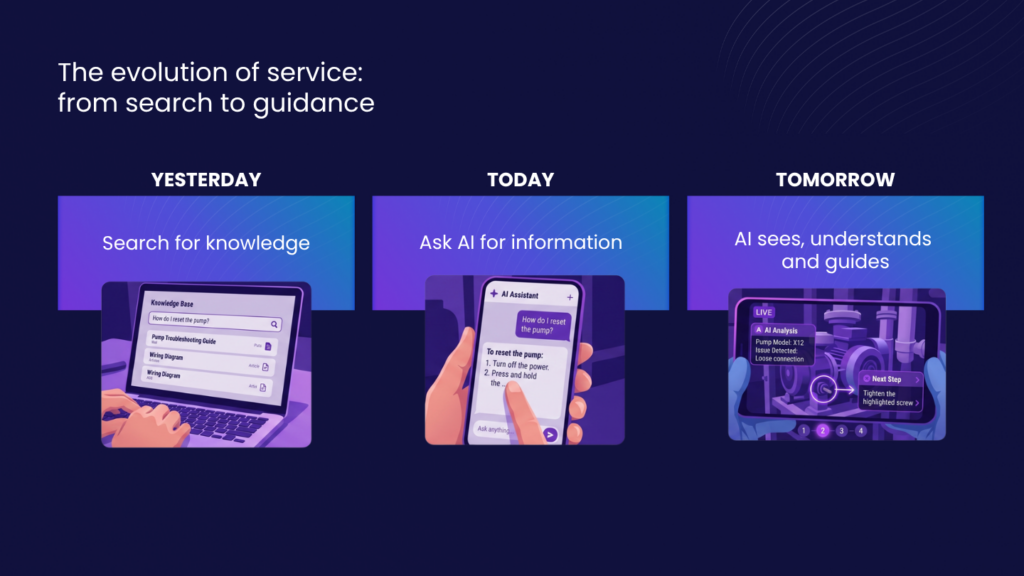
We believe the industry is moving from search to guidance.
For years, the workflow looked like this: you encountered a problem, searched a knowledge base, and hoped you found the right answer.
More recently, AI introduced a new model. Instead of searching, you ask a question in natural language and receive a contextual response.
That’s a meaningful improvement, but for many service organizations, it’s still not enough.
Technicians need more than information.
They need expertise.
They need context.
And increasingly, they need systems that understand both the asset they’re working on and the situation they’re facing.
The future isn’t simply AI that can answer questions.
The future is AI that can see, understand, and guide technicians in the moment of service.
That’s where we believe the industry is headed, and it’s the vision we’re building toward at SightCall.