


A SightCall perspective on why enterprise AI must move beyond retrieving data to learning from work.
I recently read Metrigy’s argument that data architecture will determine whether enterprise AI succeeds. Their central point is hard to disagree with: if data is fragmented, poorly governed or difficult to access, even the best AI cannot reliably get the context it needs.
The result is inconsistent answers, unreliable RAG and AI projects that struggle to move beyond the demo stage.
Metrigy argues that the foundation is getting the right data to the model, in the right form, at the right time. I agree. But I think that solves only part of the problem.
As AI moves beyond answering questions about documents and starts helping people solve real operational problems, access to information is not enough. AI also needs to understand what the organization has learned from doing the work: what happened, what succeeded, where it applies and why it should be trusted.
The challenge is no longer only data architecture.
It’s also “knowledge architecture.”
The problem with “clean data” is that real work is messy
In customer service and field service, some of the most valuable knowledge in a company never makes it into a manual, FAQ or knowledge base. It’s created while people are doing the work.
It’s the technician who discovers that the troubleshooting sequence does not work for a particular equipment revision. It’s the support expert who knows how to distinguish between two problems that look identical in a ticket. It’s the installer who learned after dozens of deployments that one small adjustment prevents a recurring problem.
This kind of knowledge comes from experience and real-world context. It’s valuable, but capturing it presents a different challenge.
Real interactions are messy.
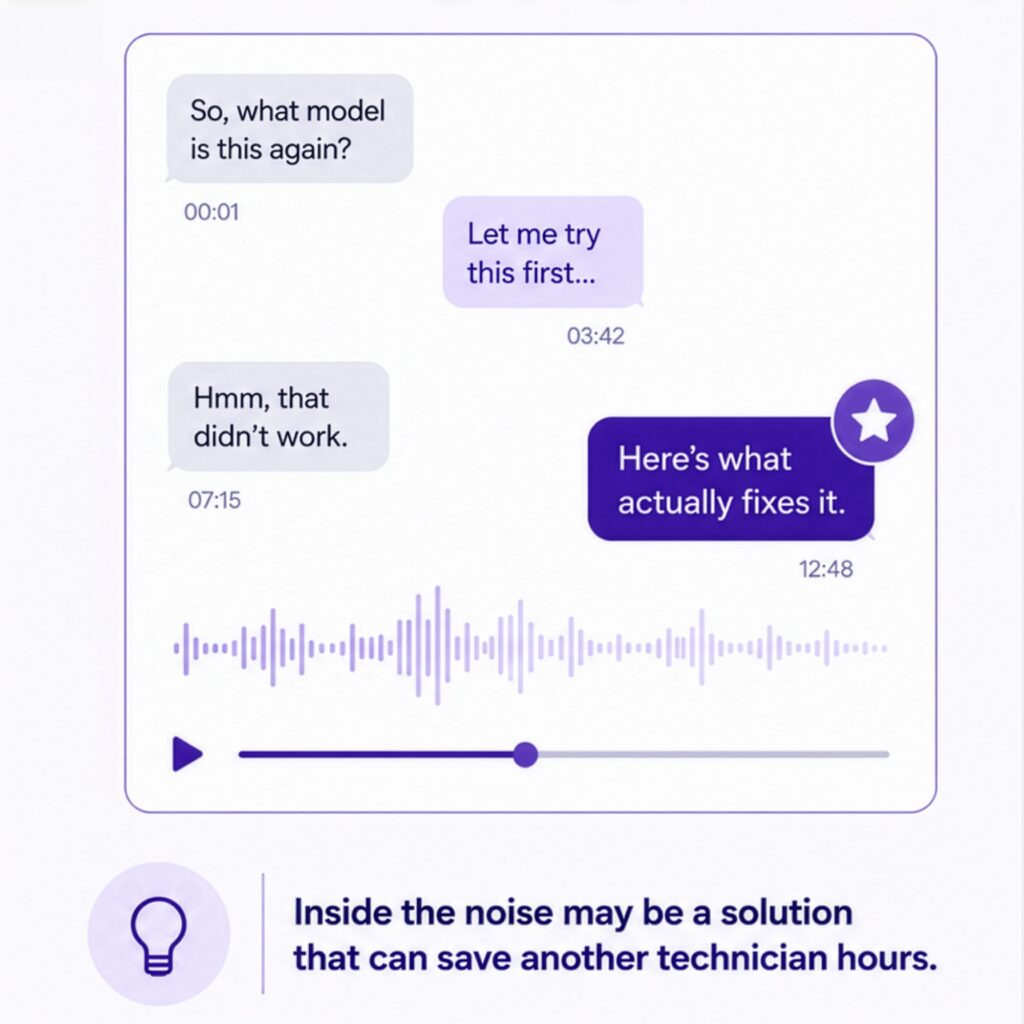
A remote visual support session might contain small talk, long pauses, incorrect assumptions, failed attempts, and irrelevant observations. But hiding inside that interaction may be a solution that could save another technician hours when the problem occurs again.
That’s why I don’t think the answer is simply to clean all of this information before AI can use it. Asking people to review every interaction, remove the noise and decide what’s worth keeping creates a whole new bottleneck.
At enterprise scale, that approach won’t work.
The better question is: How can AI learn from these messy, real-world interactions without treating everything in them as knowledge?
Ingest broadly.
Curate intelligently.
I think a better approach is to separate evidence from knowledge.
Keep the original service interaction intact as the source of truth, including who created it, when it happened and who can access it. Then use AI to turn that evidence into usable knowledge.
AI can identify the problem and resolution, extract procedures, connect them to the right products, parts and symptoms, flag duplicate or conflicting information, and assess confidence before anything becomes trusted, reusable knowledge.
AI does the first round of sorting and analysis. Humans shouldn’t have to review and clean every interaction before the system can learn from it.
But automation doesn’t automatically equal “trustworthy.”
Yes, AI can extract and organize knowledge at an enormous scale, but it can also misinterpret conversations, miss context or generate incorrect conclusions. Anything extracted from raw interactions needs a way to be verified, traced back to its source and escalated for human review when confidence is low.
You don’t want to automatically turn every interaction into knowledge. The goal is to automate the work required to identify what’s worth trusting and reusing.
Fragmentation is not only a storage problem
Bringing all your service data into one place, or making it searchable through the same system, solves the problem of access. But it doesn’t solve the problem of understanding.
Imagine 500 service interactions that each describe the same failure in different ways. Customers use different language. Symptoms vary. Product versions change.
A search system can make all 500 interactions easier to find, but it may not understand how they relate.
It may not recognize that each interaction describes the same failure, that one workaround only applies to version 3.2, that another has since been disproven, or that several experts independently arrived at a better solution.
That’s semantic fragmentation. The information is accessible, but the relationships and meaning within it are still disconnected.
This is exactly where approaches like knowledge graphs can help. Instead of treating every interaction as an isolated piece of information, they make the connections between problems, products, symptoms, versions and resolutions explicit.
There’s evidence that this can improve results. A 2024 LinkedIn study found that adding a knowledge graph to traditional RAG improved retrieval quality and reduced median issue-resolution time by 28.6% after deployment.
Microsoft’s GraphRAG work follows the same basic principle: enterprise data becomes more useful to AI when it can understand the relationships within that data, not simply search across it.
From data lake to expertise layer
This is the direction we’re pursuing with XK, SightCall’s expertise layer. The goal is not to replace a company’s LLM, RAG system, chatbot or AI agent. It’s to give those systems something they often lack: a reusable understanding of how the organization actually solves problems.
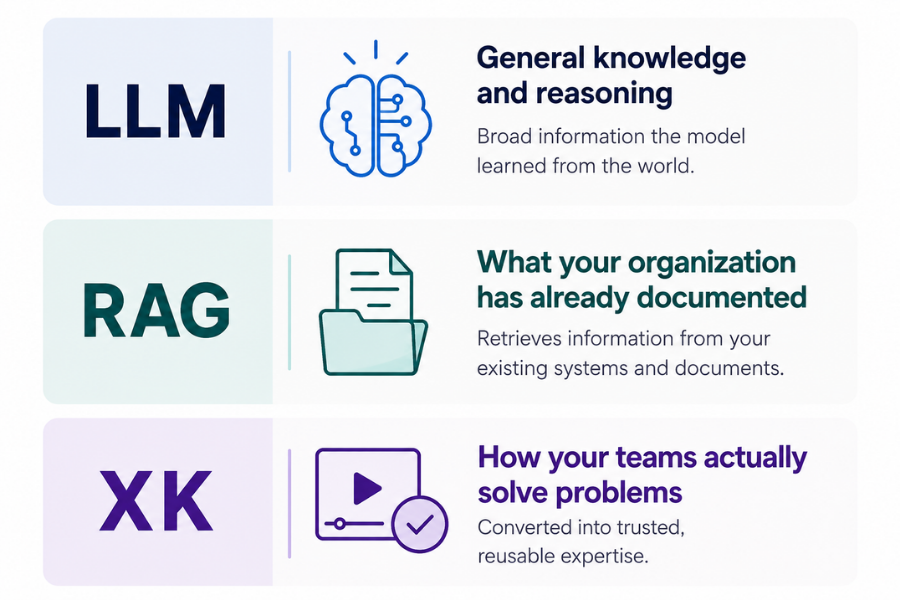
The progression is simple. A general LLM brings broad knowledge and reasoning. RAG adds what the organization has documented. XK adds what people have learned through doing the work.
That means turning real customer and service interactions, including remote visual support sessions, into structured, connected knowledge. XK can identify and connect the products, symptoms, procedures, parts, outcomes and expert actions within those interactions, to build a clear picture of what happened, what worked and where that expertise applies.
The original interaction remains the evidence. The expertise extracted from it becomes an organizational asset that can be trusted, reused and shared with the systems and people that need it.
Audit the knowledge,
not just the pipeline
Strong AI governance requires more than knowing where information came from. We also need to know why a piece of knowledge should be trusted.
If AI turns a service interaction into a troubleshooting article, procedure or recommendation, that knowledge should include its history. What interactions support it? Which products and versions does it apply to? When was it created? How confident is the system? Has an expert reviewed it? Has newer evidence confirmed or challenged it? Which version should people and AI use today?
That changes the auditing question from “What information did the AI search?” to something much more useful: “Why do we believe this is true, and when should it be used?”
Research from Microsoft points in this direction. Its VeriTrail work explores ways to trace AI-generated claims back through each step of their creation to the original source material.
The broader principle is simple: If AI is going to turn real work into organizational knowledge, the connection to the original evidence can’t be lost along the way.
The next AI foundation is not more data. It’s better memory.
Enterprise AI still needs a strong data foundation. It needs access to the right information, clear permissions, reliable sources and the ability to work across systems.
Access to more data is only part of the problem. The next step is helping organizations learn from what happens every day.
When a technician solves a difficult problem, that solution can become a reusable procedure. When experts repeatedly make the same diagnosis, that pattern can become part of the organization’s knowledge. When new evidence contradicts an existing answer, it can trigger a review.
And when someone discovers an undocumented workaround, that expertise can be captured instead of disappearing when the interaction ends.
That’s the opportunity we see for XK and the broader idea of an expertise layer. It’s not another place to store information, but a system that turns real work into trusted, reusable knowledge.
AI learns how the organization solves problems, so every resolution has the potential to make the organization more knowledgeable for the next one.