
SightCall Sessions: Episode 9
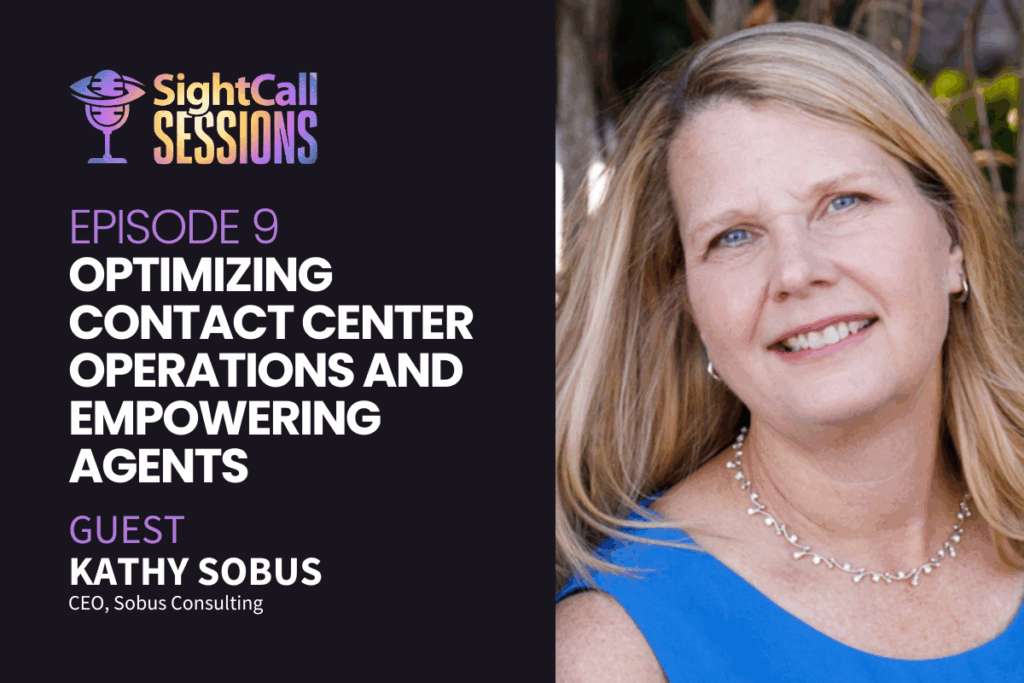
In this episode, industry veteran Kathy Sobus shares insights from over 30 years in customer experience, IT, and AI innovation.
Drawing on her work with Avaya, ConvergeOne, and now Sobus Consulting, Kathy unpacks how contact centers are evolving in an era of empowered customers and sophisticated digital tools. She introduces the concept of agent impairment, discusses the challenges of technology adoption, and emphasizes why agent experience is inseparable from customer experience.
The conversation explores how organizations can use AI and smart CX technology to reduce friction, boost ROI, and prepare for the future of customer engagement.
What You’ll Learn:
-
How “agent impairment” impacts performance and CX
-
Why technology adoption often fails
-
The link between agent empowerment and customer satisfaction
-
The real role of AI in contact centers
-
How to calculate true ROI on CX investments
Introduction
Pete:
Kathy Sobus has over 30 years in the IT business with organizations across a wide range of industries. She’s a recognized authority in AI, collaboration, customer experience, and security. Recently, she launched her own business transformation strategy company, Sobus Consulting.
Kathy, can you start by telling us a little bit about your background?
Kathy:
I’ve been in the business for over 30 years, and I spent much of that time at Avaya in different roles. I led a global group that provided tier-two technical expertise to customers and business partners, and I also helped architect Avaya Learning, developing a certification process and achievement goals for participants.
I’ve been in contact centers and customer experience for a long time, collaborating with groups across the company, including R&D. I’m happy to say I hold over 13 patents, and I’ve always been passionate about helping organizations think differently about customer experience—how they approach it, and how they can benefit from doing it better.
After Avaya, I moved into systems integration, spending about ten years at ConvergeOne before starting Sobus Consulting. I wanted to take everything I’d learned and help companies develop what customer experience truly means for them.
How Customer Service Has Changed
Pete:
What are some of the biggest changes you’ve seen in customer service—or maybe what hasn’t changed?
Kathy:
The biggest change is how people engage with businesses. Customers don’t just pick up the phone anymore. They do their research, try to self-serve, and make decisions long before they reach out to a company.
Businesses need to realize that the customer journey is happening—with or without them—and smart organizations embrace it. That’s where the real productivity and cost benefits come from. There’s also been a huge shift in the technology supporting that journey.
The Evolution of the Customer Service Agent
Pete:
And how has that shift affected customer service representatives?
Kathy:
Customers today are much more informed. They come in knowing what they want because they’ve already done the research. That changes the dynamic—agents have to be more prepared, knowledgeable, and empowered to meet those expectations.
Understanding Agent Impairment
Pete:
You’ve talked about the “high cost of impairment.” Can you explain what that means?
Kathy:
Agent impairment refers to the things that are beyond an agent’s control that prevent them from doing their job effectively. When agents log in, they expect all their tools to work—systems, software, and connections. When those systems fail or even slow down, it causes delays and frustration for both agents and customers.
For example, when an agent says, “My system is slow today,” that’s impairment in action. It affects performance metrics and customer satisfaction.
I’m currently an advisor for a company called Truiem, whose software, True Experience, identifies these breakpoints in real time—whether agents can connect to key applications or if there are intermittent failures. By seeing and fixing those issues, companies can dramatically improve both agent and customer experience.
Barriers to Technology Adoption
Pete:
What’s the biggest challenge companies face when trying to adopt tools like that?
Kathy:
Awareness is the first hurdle—many organizations simply don’t know there’s a better way. They’re busy running their business and accept problems as “just the way it is.”
Then comes compatibility: will this new software work with everything else they already use? And finally, process alignment. Companies often forget to adjust their internal processes when they implement new technology. Without that, they can’t realize the full benefit.
At Sobus Consulting, we help clients ensure their technology, processes, and people work together.
The Importance of Agent Empowerment
Pete:
You’re also a big advocate for agent empowerment. How do you see that playing out today?
Kathy:
I believe happy agents make happy customers. When agents feel supported, trained, and equipped, they stay longer and do better work.
Before COVID, agents typically left for another contact center job or moved up within their company. Now, many leave the industry entirely. That’s a big change—we’re losing the craft of great customer service.
Some companies are addressing this by organizing agents into “pods” that focus on specific customer groups or regions. Agents get to know their customers, their communities, and even local events, which helps them build real relationships. That personal touch leads to better outcomes.
The Role of AI in Modern Contact Centers
Pete:
And how do you see AI fitting into this picture?
Kathy:
AI is becoming essential because customer inquiry volumes are higher than ever. AI can handle the easy, repetitive tasks, freeing agents to focus on complex, high-value interactions.
But that also means agents don’t get “breather calls” anymore—every interaction is challenging. So while AI helps with volume, it also raises the need for skilled, emotionally intelligent agents.
We need to prepare for that shift. Talk time might increase, even as total call volume decreases, because agents are dealing with tougher issues.
Rethinking Metrics for Success
Pete:
Do you think success metrics are changing because of that?
Kathy:
I hope so. Metrics like first contact resolution and customer lifetime value are much more meaningful than traditional stats like average handle time or call abandonment.
Companies should focus on outcomes—solving problems and building loyalty—rather than just speed. And while tools like NPS (Net Promoter Score) are still useful, I think we need to go deeper into understanding what satisfaction really looks like.
The Joy of Consulting
Pete:
What’s your favorite part of consulting?
Kathy:
Working directly with customers. I love understanding their business, identifying ways to make it better, and seeing those recommendations come to life.
Whether it’s recommending technology, optimizing processes, or connecting them with vendors they didn’t know existed—that’s where I find the most joy. Seeing clients execute on a plan and realize real change is incredibly rewarding.
The Future of Contact Centers
Pete:
Finally, if you put on your “future goggles,” what do you see for contact centers in the next few years?
Kathy:
I think we’ll see AI become deeply embedded—both for customers and for agents. Self-service will continue to grow, and companies will use AI to support not just contact center agents but anyone in the organization who interacts with customers.
In many cases, there are people who aren’t technically “agents” but still answer customer questions—engineers, specialists, or healthcare staff. I’d love to see companies extend CX technology to those roles too, focusing on quality over quantity.
And we need to rethink the term “agent.” Not everyone who provides customer experience support fits that label anymore. The future is about empowering everyone who serves the customer, wherever they sit in the organization.
Closing and Contact Info
Pete:
That’s such a great point. If people want to learn more or get in touch with you, what’s the best way?
Kathy:
They can visit SobusConsulting.com and schedule a 30-minute meeting. I’d love to connect and see how we can help.
Pete:
Perfect. Kathy Sobus, thank you so much for joining me.
Kathy:
Thank you for having me!