

Allianz uses remote visual assessments to resolve approximately 30% of claims remotely, improving customer experience, reducing travel, and saving over €4 million annually.
A burst pipe in an apartment in Madrid. A minor car accident on the outskirts of Munich. A hailstorm moving quickly across Switzerland.
For insurance leaders, these moments all trigger the same tension.
Customers want fast answers and reassurance, while claims teams must balance speed, accuracy, cost, and compliance.
For decades, the default response was physical inspection. An adjuster drove to the site, assessed the damage, documented the claim, and only then could the process move forward.
It worked, but it was slow, expensive, and increasingly out of step with how customers expect to interact today.
Allianz, the world’s largest insurance company, saw this friction early and decided to do something about it.
The challenge: Modernizing claims without losing trust
Operating across dozens of countries, Allianz faces a scale few insurers can match. Any change to claims handling must work across markets, regulations, and lines of business. It must also preserve the human judgment and empathy that customers expect at critical moments.
Allianz set out to modernize claims with a few clear goals in mind:
- Make the claims experience faster and less stressful for customers
- Improve efficiency and productivity for adjusters
- Reduce unnecessary travel and operational cost
- Create a foundation for long‑term sustainability
This was not about replacing adjusters. It was about enabling them with better tools.
Looking beyond insurance for answers
At Allianz’s scale, even small inefficiencies in claims handling translate into millions in cost, delays, and customer dissatisfaction.
When Allianz began exploring visual assistance in 2015, the insurance industry offered few reference points. Instead of waiting for the market to catch up, Allianz looked to other industries where remote visual support was already proving its value.
That search led them to SightCall.
What stood out was SightCall’s ability to deliver secure, real‑time video that worked on a customer’s smartphone, without friction, and without compromising data protection.
Just as important, the SightCall team was able to move fast and co‑develop alongside a large enterprise.
The solution: Visual claims, guided by experts
With SightCall, Allianz enables adjusters to conduct live video assessments remotely.
Instead of dispatching someone on site, an adjuster can connect instantly with a policyholder, see exactly what they see, and guide the inspection step by step.
During a session, adjusters can:
- Visually assess damage in real time
- Capture high‑quality photos and documentation
- Collect signatures and key claim data
- Collaborate with technicians and craftsmen when repairs are needed
The result is a claims interaction that feels personal, efficient, and transparent. Customers remain in control, and adjusters retain full oversight of the decision‑making process.

“SightCall allows Allianz adjusters to perform live video assessments of damages and makes filing a claim for their customers fast, easy and convenient.”
How value evolved over time
As the program scaled, Allianz saw the impact expand beyond its original objectives.
Because SightCall is a SaaS solution, Allianz was able to respond quickly during COVID by equipping more than 1,000 employees with safe, contact-free access in less than a week.
At first, the benefits were operational. Fewer site visits meant lower travel costs and faster cycle times. Claims could be resolved more quickly, and adjusters spent more of their day assessing claims instead of driving between them.
Over time, the focus shifted toward customer experience. Remote visual assessments reduced waiting times and improved satisfaction, especially in moments when customers were already under stress.
More recently, another dimension became impossible to ignore: sustainability.
Every avoided trip also meant avoided emissions. What had once been a side effect of efficiency became a measurable contribution to Allianz’s environmental goals.
Turning usage into measurable impact
Working closely with SightCall, Allianz began tracking sustainability metrics directly tied to real claims activity.
Not estimates. Not assumptions. Actual data generated by how the platform is used.
Today, Allianz conducts approximately 230,000 remote assessments per year using SightCall, representing around 30 percent of all assessments.
At that scale, the impact is significant:
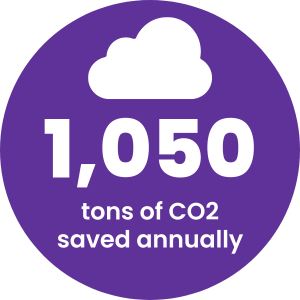
- Around 1,050 tons of CO₂ saved annually
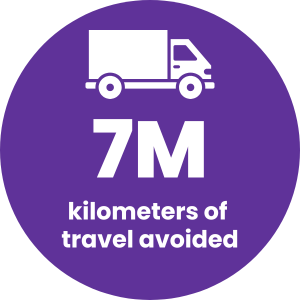
- Approximately 7 million kilometers of travel avoided each year
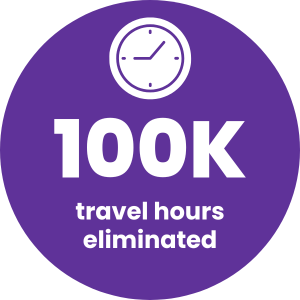
- More than 100,000 travel hours eliminated
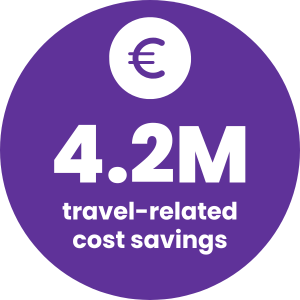
- Roughly €4.2 million in travel‑related cost savings per year
To put the emissions savings into perspective, this is equivalent to the annual absorption capacity of about 7,000 adult trees.
Just as important, Allianz is deliberate about credibility. These figures reflect direct, traceable outcomes from avoided travel. They are not inflated or speculative.

WEBINAR: Quantifying Sustainability
Allianz shares the positive impact of visual assistance on decarbonization, resource efficiency and safety. Learn how the SightCall platform enables service organizations to measure and track accurate C02 savings and leverage data insights from your own fleet to set ESG targets for your service organization.
How Allianz uses the data
The sustainability data generated through SightCall plays multiple roles inside Allianz.
First, it provides a baseline. Early deployments, such as in Spain, serve as reference points for other regions starting or scaling remote claims.
Second, it supports optimization. Claims leaders can identify where network design and workflows can further reduce travel, time, and emissions.
Finally, it enables engagement. Allianz can share the environmental impact of remote assessments with customers and partners, reinforcing that choosing a visual claim is a positive contribution, not just a convenience.
A partnership built to evolve
For Allianz, the success of SightCall is not tied to a single feature or moment. It is the result of a long‑term collaboration that continues to evolve alongside changing business priorities.
What began as a way to modernize claims has become a strategic lever. One that improves customer experience, empowers adjusters, and delivers measurable sustainability outcomes at scale.
For insurance leaders across EMEA, and increasingly in North America, Allianz’s journey offers a clear lesson. Modernizing claims does not require sacrificing trust or human expertise. With the right tools, it can strengthen both.